
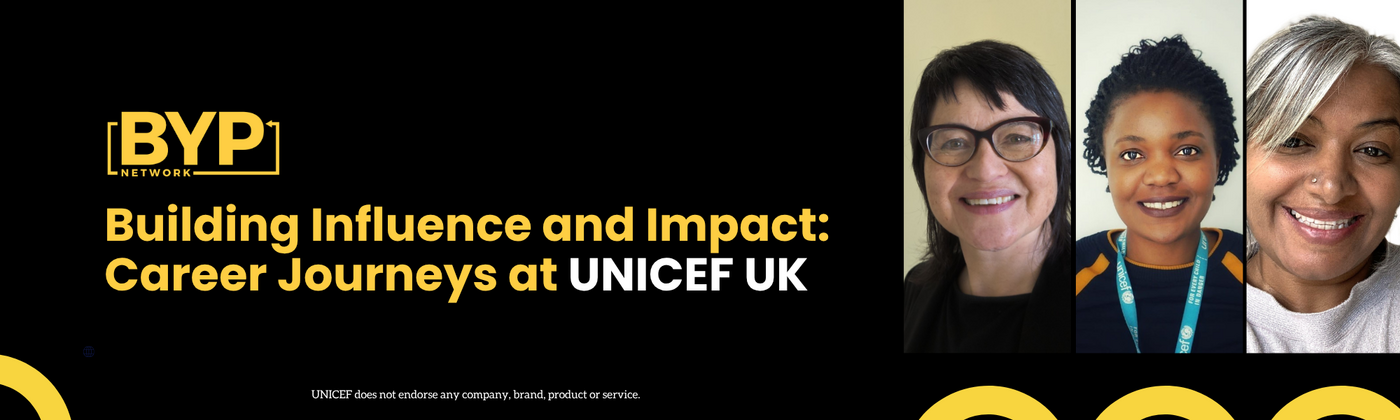
Building Influence and Impact: Career Journeys at UNICEF UK
In this exclusive feature with UNICEF UK, we sit down with three leaders who embody the transition from talent to institutional influence. Shaulan Chanlewis, who is helping to shape the voice of the organisation as Copywriter and Editor, the latest role in her 25 year tenure, Margaret Banjo, who has spent 9 years at UNICEF and now steering the machinery of Programme Funding Operations and Milly Lawrence, who, over her 5 years at UNICEF, is now architecting the roadmap for UNICEF UK’s future as Head of Strategic Planning.
They share what it looks like to build a career defining legacy at a world leading NGO, and why their presence isn't just about representation, it’s about the expertise that keeps the mission alive.
People see the humanitarian ads, but what does a high impact Tuesday morning actually look like for a professional in your department?
Milly: A high impact Tuesday morning in Strategic Planning is all about turning big ambitions into clear, practical direction for the organisation. You might find us shaping the next phase of our strategy development whether that’s refining the organisational priorities following a strategic review, pressure testing directorate strategies, or aligning our planning timelines so teams across UNICEF UK can move in step. Much of the work is about taking complex inputs from across the organisation and turning them into something usable: frameworks, decision points, and the “so what?” that helps leaders act with confidence.
Shaulan: We could be sharing ideas for a new creative or working on the latest set of social ads. If we’re supporting an emergency appeal, we’ll be fact checking, waiting on approvals, and swiftly creating content to raise awareness and donations. Equally I could be editing key messages or reports. As the copywriter and editor, I work with graphic designers, video and photo producers, account managers and a traffic manager (who keeps us all on track).
What is the 'sticking factor' for you? In a competitive market, why have you chosen to build your long term legacy specifically at UNICEF UK?
Margaret: I was raised in Malawi, a deeply patriarchal society, and grew up with a first hand understanding of the particular vulnerabilities I faced as a girl. Those early experiences shaped my sense of justice and my awareness of how often it’s missing. Working on children’s rights at UNICEF UK feels strongly aligned with my values. Fast forward a few years, and I now see this work through my sons’ eyes. The injustices are still there, and the vulnerabilities children face around the world remain very real.
Here at UNICEF UK, people are kind, well intentioned, and genuinely committed to doing good work. Programme Funding Operations, my team, is more than enough of a sticking factor to power me through even the longest run of PowerPoint slides.
Shaulan: UNICEF’s cause will always resonate for me – a better world for every child.
A few years into my time here, I became a parent through adoption. UNICEF UK’s family-friendly policies gave us time to get settled. My children were four and six, old enough to be interested in my work life, and I think it helped them trust that I was committed to them. My experience of advocating for children’s rights at work and as a parent reinforced my commitment to both and shaped my participation. As they grew, my children took UNICEF’s cause to their own hearts, supporting so many initiatives and making me very proud of their own values.
If someone asked you to sum up your UNICEF journey in one word or sentence, what would it be?
Shaulan: An exploration of what it takes to support child rights through collaboration, dedication and inspiration with an amazing set of colleagues and partners in a constantly evolving organisation.
Milly: My journey has been defined by learning how to influence the decisions that shape our humanitarian impact while growing as a strategic leader.
Margaret: Purpose, people, and persistence with just enough PowerPoint to keep things interesting.
What opportunities played a role in your growth here and how can new Black talent find that same support?
Milly: One of the biggest accelerators to my growth at UNICEF UK has been the investment in my development through programmes like the Imperial Business School and Corndel Executive Development Programme level 7, which pushed me to stretch my strategic thinking and build real confidence as a leader. That support has been just as meaningful as the formal learning itself. What it’s shown me is that growth here isn’t something you do alone. It’s built through communities, your cohort, your team, and the senior leaders who take time to champion you.
Seek out sponsors who speak your name in rooms you’re not in, peers who share knowledge freely, and managers who help remove obstacles rather than add them.
Most importantly, you don’t need to dilute who you are. My own growth has come from standing firmly in my identity and lived experience and being backed by people and programmes that recognise the value in that.
Shaulan: I’ve been able to bring in my life experience by joining and supporting colleague networks, like Inclusive UNICEF, bringing me into contact with brilliant people inside and outside of UNICEF UK. For a year, I co-chaired (and then solo-chaired) Inclusive UNICEF and now am part of the Racial Justice Network and the LGBTQIA+ network. I’ve also volunteered in our anti-racism working group.
Outside of work, what’s a hobby, obsession or guilty pleasure that fuels your creativity or joy?
Margaret: Detective shows. Nothing too deep or cerebral, think Death in Paradise or Father Brown. They bring me endless joy and feed my love of puzzles, both on screen and in real life. I like to think of this as my dyslexic superpower: the ability to spot connections between seemingly unrelated things.
Shaulan: Exploring my hometown! On my own, with friends, long walks, mooching around the shops, volunteering with the park ranger, being a reading volunteer in school.
Milly: Outside of work, the things that bring me joy are the ones that give me space to breathe, especially because, as a carer, I don’t get a huge amount of free time. When I do, you’ll usually find me in my garden tending to my veggie patch. There’s something grounding about watching things grow slowly and steadily; it’s a rhythm that pulls me out of the urgency of work and recenters me. I also love cooking Bengali food, particularly when I can use ingredients that I have grown myself.
For a Black Young Professional entering the building today, what is the one 'unwritten' rule of navigating a global agency to ensure they aren't just working but moving toward leadership?
Margaret: Self awareness and the willingness to do the work. Know your strengths, where you need to grow, and what triggers you. Then actually do something with that knowledge. Ask for feedback, be sincere in the ask, and follow through.
For Black colleagues, know your triggers. One of mine is the minimisation of racial dynamics. I’ve had to learn how to recognise that response, neutralise it, and respond without either absorbing the issue or escalating it unnecessarily. That means giving people the grace to come back from mistakes but also expecting ownership when they do.
Milly: The unwritten rule is this: don’t just deliver, be intentional about being visible. In a big global agency, great work alone won’t automatically move you toward leadership. Make sure people understand how you think, not just what you produce. Share your reasoning, your ideas, and your perspective in the rooms you’re in, and actively seek out people who will champion you into the rooms you’re not in yet. Take up space with confidence. Your lived experience, cultural insight, and way of seeing the world are not add-ons; they're strategic assets. The moment you stop shrinking your voice to fit the environment and start allowing the environment to benefit from what you bring, you shift from simply doing the work to shaping it. That’s where leadership begins.
At UNICEF UK, Black excellence isn't a temporary initiative, it is a permanent fixture of their institutional strength. If you are ready to align your high level skills with a mission that changes the world, the door is open.
Don't just watch the mission happen. Come and build the track record.
