
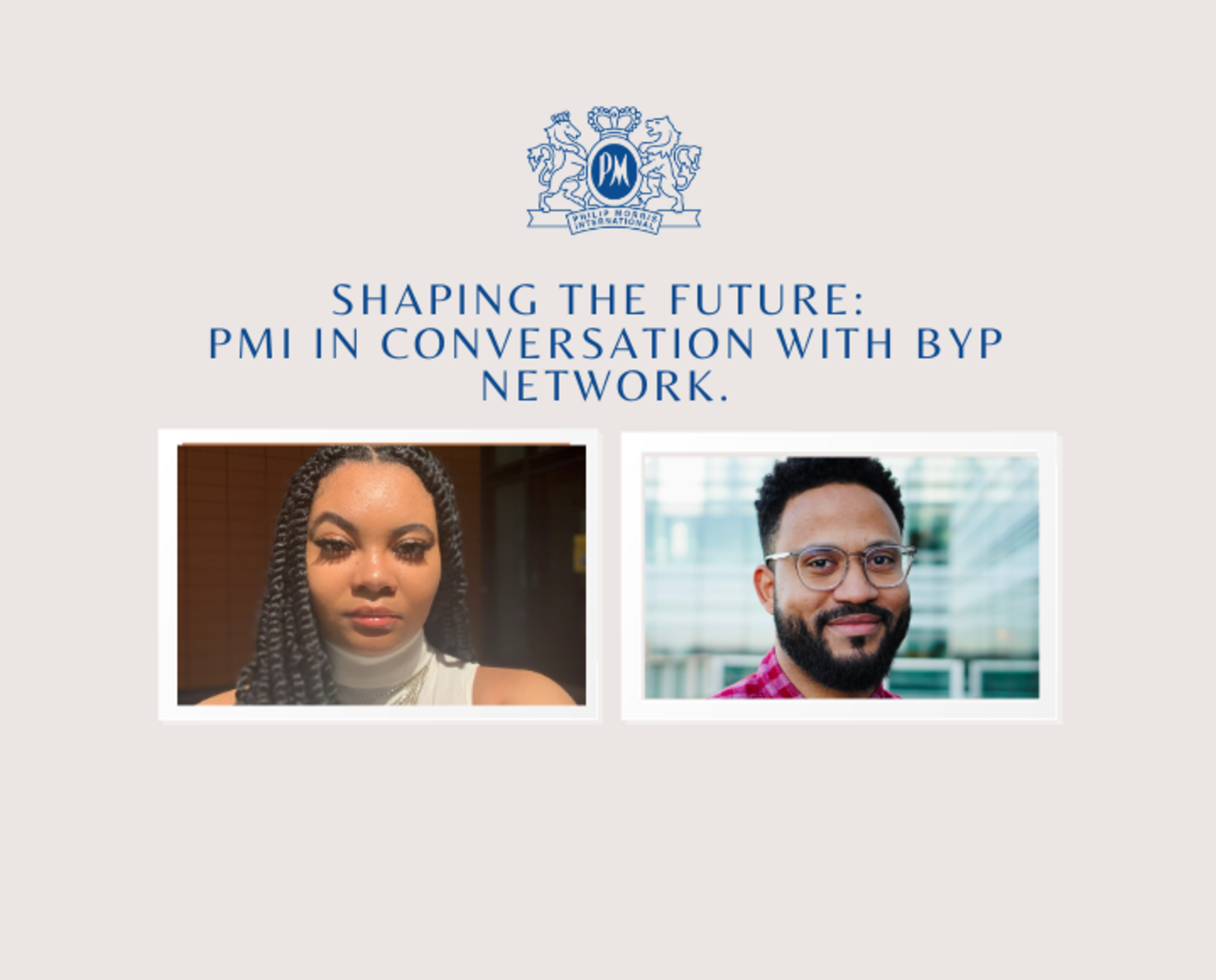
Shaping the Future: PMI in Conversation with BYP Network.
Our focus is on creating an environment where our employees from across the globe can be their true selves at work, contribute their best, support each other, and drive the innovation and consumer-centricity needed to help us achieve our vision of a smoke-free future. Our employees, Rudolphe and Jod, and I had a conversation with BYP Network on how it is to work with PMI.
Rudolphe Cabral
Please, can you share a bit about yourself and your career journey?
I was born in Guinea-Bissau, West Africa, and grew up in Lisbon, Portugal, where I studied and started my career in consultancy. I've worked on projects across multiple locations - Portugal, Angola and Spain - and multiple industries - banking, the public sector, telecommunications and manufacturing. I'm currently based in London.
PMI caught my attention with its international presence and mobility, and the business transformation it's going through. I never thought a company like PMI would disrupt itself and be at the forefront of innovation. People don't normally associate PMI with Technology or Digital.
At PMI, I've built my career around business transformation powered by technology, with roles in Tech, Data and now Digital & Marketing. As Head of Digital, I look after the consumer lifecycle from awareness to conversion and retention. In 2020, I co-founded Djassi Africa with the aim to empower African tech-enabled start-ups and advance Black Founders in the Diaspora.
What are some of the challenges you faced when starting your role, and how did you overcome them?
When I started my career, the corporate environment in Europe, especially in Portugal, was very different to today. As a Black person, you had to stand out to be given the same level of trust and opportunities as others. Every new relationship, with colleagues or clients, meant proving myself over and over. It's still happening today, however, it's much better as things have progressed, especially in London, where you find a much more diverse business ecosystem.
What are your thoughts on employees from diverse backgrounds having to ‘manage upwards' within their establishments?
Underrepresented groups face the issue of relatability while pursuing advancement, whether due to gender, race, or other criteria. Senior members who don't share their identity can fail to understand them or their reality. This is where I believe companies can do better to improve inclusion. Senior leaders should be the ones breaking barriers. They should be curious and aim to create fairer environments.
Are there any books, podcasts or series that have inspired you regarding self-development that you would recommend to our network members?
If I can recommend one book, it has to be 'How Will You Measure Your Life' from Clayton M. Christensen. It helps put things in perspective, I think everyone should read it at least once. I also recommend subscribing to Harvard Business Review, it's a great way to stay current with what's going on in different areas, and to find resources on leadership, ways of working, innovation, etc.
Our mission at BYP is to change the Black narrative. What does changing the Black narrative look like to you?
For me, it is about having a voice, which can only be achieved if we own our narrative.
It is also about leading by example by showing that there is a better way, where we can all be free and celebrate our differences across gender, ethnicity, culture, and other dimensions.
Jodi Rose
Please, can you share a bit about yourself and your career journey?
I'm Jodi, a young, Black, neurodivergent woman! I graduated from De Montfort University and immediately started working at PMI on the EVOLV Graduate Programme. I started in the People & Culture team, then moved to Sales. Next, I'll move into my permanent role continuing my time with the fantastic Customer Service Centre (CSC) team as a Deployment Lead, where I'm responsible for leading and orchestrating different campaigns to deliver to our retailers.
I initially underestimated the importance of the Customer Service Centre (CSC) team for our consumers and retailers.
The CSC team is a revenue generator and is a key part of our customer experience strategy. They help us to build relationships with customers, understand their needs, and go above and beyond to help them.
What are some of the challenges you faced when starting your role, and how did you overcome them?
I had the challenge of starting new roles a few times as I was on a rotational grad scheme. I didn't come from a privileged background or go to a top university, and I was the only Black woman in my cohort. As a neurodivergent person, I have different energy needs than neurotypical people. I need more time to process information and make decisions, and I can get easily overwhelmed by sensory input. I dealt with impostor syndrome and was worried that the additional stress of starting a new role would make my manager feel like I was not motivated or excited about this new opportunity.
My advice is: It's important to advocate for yourself and your needs. Don't expect to be perfect. Just focus on taking things one step at a time and enjoying the learning phase. The best thing I did for myself was to view my uniqueness as a strength and use my experiences to bring new ideas to the organisation and to uplift and support others who may feel different too.
The world is changing as we know it, and higher education is no longer the only route into certain careers.
What is your advice to those who have taken a non-traditional path into their chosen fields?
Diversity in education and career pathways is essential, as it promotes inclusivity and enriches industries with fresh perspectives, innovative ideas, and a broader range of skills.
If you have taken this route or are considering it, keep going. Ignore people who say that a traditional university is the only way forward. People can be quick to judge and slow to change - do what's best for you and ignore those who try to put you down.
What are your thoughts on employees from diverse backgrounds having to 'manage upwards' within their establishments?
As someone who is early in their career and comes from a diverse background, I've walked in those shoes, and I get it. Managing upwards can feel like navigating a maze sometimes. Our views and experiences can differ from our managers, which can make it a challenge to get our voices heard. There's internalised pressure from underrepresented groups in the workforce to feel like they must consistently be a hundred steps ahead to be successful. Instead of fixating on 'managing upwards', promoting a healthy work-life balance, providing growth opportunities, and a supportive work environment are just a few ways that businesses can create a work environment where employees can thrive, in turn leading to a more productive and successful workplace.
Lastly, what are your key takeaways for our network members?
Embrace your quirks and differences. They make you who you are! I know it's not always easy to embrace and love yourself, and it's a phrase that we hear very often now, but it's worth it. When you love yourself, you are more likely to be happy, successful, and fulfilled. "What's the world for if you can't make it up the way you want it?" - Toni Morrison
To discover more about PMI, and about how we foster a diverse, equitable, and inclusive workplace read more here.
